
Many students spent February break relaxing at home or traveling with family — but one group of motivated young women rolled up their sleeves, powered up some tools, and dove into a week of hands-on STEM learning.
Thanks to a grant from RPI aimed at increasing female participation in science, technology, engineering, and math, Watervliet Jr.-Sr. High School’s technology department hosted a weeklong STEM camp for girls in grades 8-10. The funding allowed the department to purchase new equipment—from robotics kits to hydroponics systems and graphic design tools—designed to spark curiosity and encourage more young women to explore technical fields.


The camp, held during the February recess, brought together 13 students selected from a group of 48 invited participants. Although the turnout was smaller than anticipated—several students already had vacation plans—the impact was bigger than imagined.
“The goal was to provide a full week of STEM activities to females in grades 8, 9 and 10,” said technology teacher Mr. Van Vliet. “With such a small group and two teachers available, the students received a lot of one-on-one instruction and were able to use all of the woodworking machines in the lab without having to wait.”
Students were given the freedom to choose among several STEM pathways, including robotics, hydroponics, woodworking, coding, and graphic design. But once the tools came out and the workshop buzzed to life, every participant gravitated toward the same ambitious project: building a full-size Adirondack chair from wood pallets.

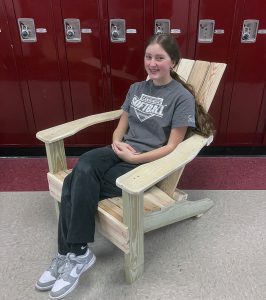

The project became the centerpiece of the week. Measuring, cutting, drilling, sanding, and assembling piece by piece, the students spent the entire camp transforming raw lumber into finished outdoor furniture—an accomplishment that required patience, precision, and teamwork.
The group expanded their STEM experience beyond the classroom when midweek the students visited the University at Albany’s makerspace to explore advanced equipment and experiment in a drone and robotics laboratory.
The camp’s smaller size created a uniquely immersive learning environment. With direct support from instructors, students gained hands-on experience operating professional-grade woodworking tools while learning problem-solving, design, and engineering fundamentals.
The exposure appears to have sparked new enthusiasm for STEM. According to Mr. Van Vliet, many of the participants left the camp eager to continue exploring technology courses and hands-on learning opportunities.
The impact of the STEM camp will continue to benefit students in the future. The equipment purchased through the grant will be incorporated into regular technology classes, expanding access to robotics, hydroponics, graphic design, and other STEM-focused projects for students.
For the young builders who spent their school break crafting Adirondack chairs and exploring cutting-edge labs, the week was more than just a camp—it was a glimpse into the possibilities waiting for them in the world of STEM.